Palafox, Palafox– What Are They Feeding You?

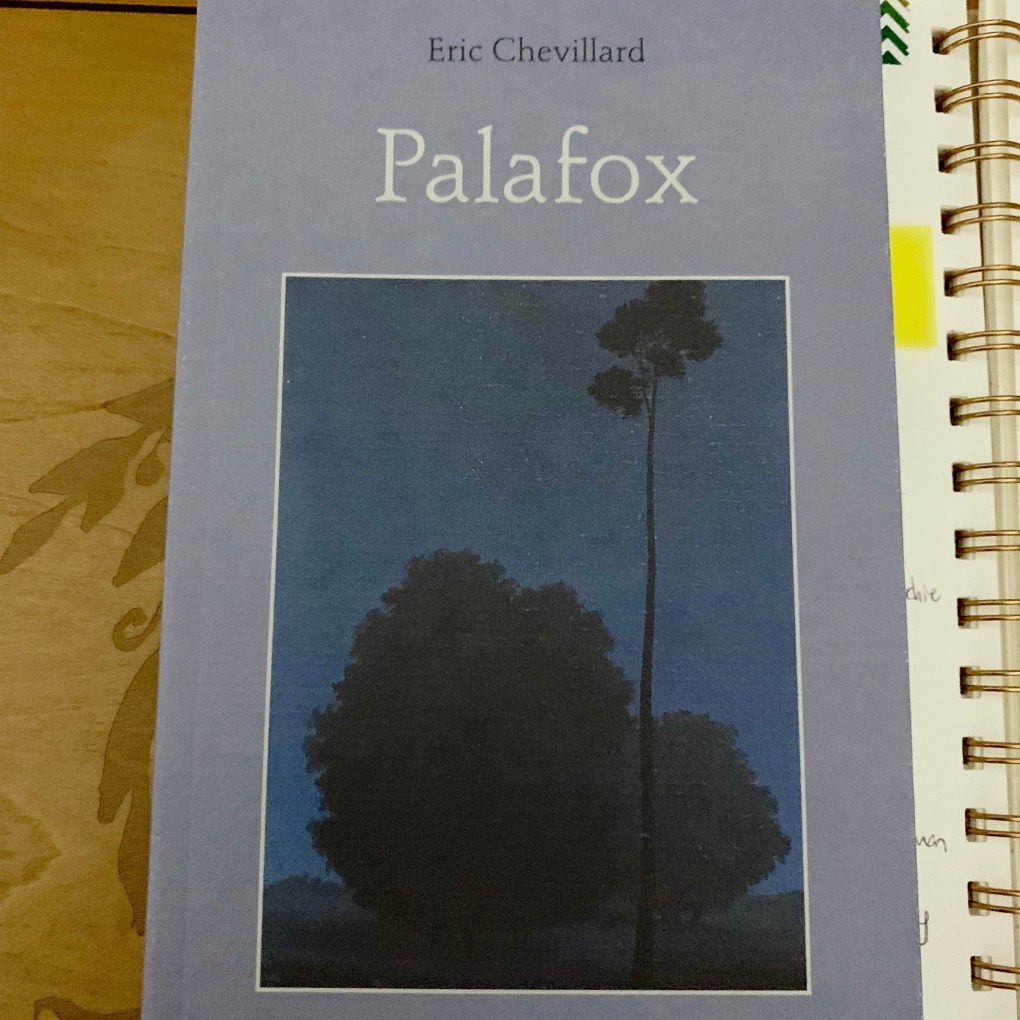
Currently Reading: Palafox by Eric Chevillard

This is what I call my Chevillard Syndrome: barely beyond page 1 of a Chevillard book/story…barely beyond the second paragraph, I have found that a smile has crept over my face. And it gradually turns into a full grin, and ultimately just ugly-cry-laughing.

Oh Chevillard! There’s just this…particular lilt to his narrative, so inherently Chevillard-y. It sets me into a specific this mind-frame  when I get into his work, even if it has been 8 months since I last read him. Mind you, I have not read much of his oeuvre (yet), but I find his narrative tendencies habitual and reassuring. Like revisiting an old friend.

I read Crab Nebula about one year ago. Palafox was penned first. Aside from the same Chevillard-y tone, the stories are very similar. Crab Nebula is comprised of a series of unrelated passages, describing an overall undefinable human named Crab. Similarly, Palafox is about an undefinable animal, but descriptions of him are set within a story. Palafox’s descriptives keep changing through the narrative- he is born from an egg, he has feathers, fur…seemingly scales and horns. He weighs 2 tons, yet fits in a paper  envelope. You can ride upon his back in water, then tuck him under your arm as you get out. And it is not that he is a changeling…it is that he is all of these things at once. It’s absolutely amazing! Amazing when you simply let go of reasoning with it. Rest assured, it’s all intentional, so just roll with it.

What Palafox reminds me of:

  1. (Early on) The Magic Mountain, but paced much better (instead of spanning 700+ pages, more like 136). In that, early on, I just want to hear about the descriptives of Palafox, but there are frequent asides about a war, pieces of furniture, and the specific study and experiences of various zoologists. It’s like when I read The Magic Mountain and all I wanted to read about were the spellbinding interactions between Hans Castorp and Madame Chauchat (“My God! My God!”), but these scenes are encased within long passages involving the pedantic humanist. Erg. But (sob!) that is the beauty of the book!
  2. Kafka’s Odradek. A description of a star-shaped spool of thread, seemingly many contradicting things at the same time. “I dare you to draw the Odradek!” I said in my head smugly. Then I Googled images of it, and indeed, people have drawn/designed the Odradek. Well, go you guys.

Another think I love about Palafox is the undefinable narrator, as equally undefinable as Palafox himself. The story seemingly starts out third person omniscient, but toward halfway I started detecting “I’s” and “We’s.” Who is the narrator? He seems within the mix of the action, always present in every circumstance. But he supplies no self-identification. I cannot place him as a family member of Algernon and Maureen, nor a zoologist. The most I can glean out of him is that he once killed a boar. What kind of narration is that? First-person-omniscient/omnipresent-yet-removed? Well whatever it is, it is brilliant. Who wouldn’t want to write like that? Complete authority over the story, ostensibly present within the story, but otherwise exuding no influence/bias?
Preach!

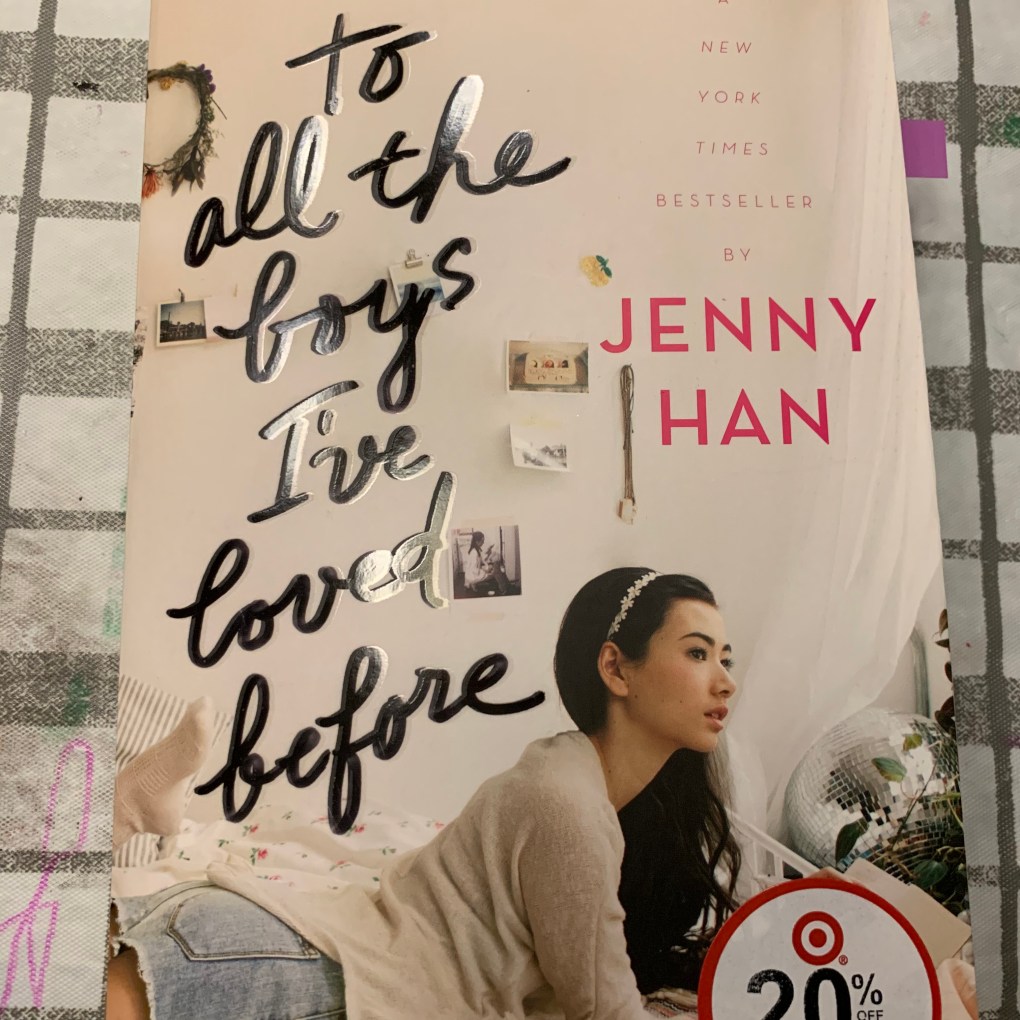
Currently Reading: To All the Boys I’ve Loved Before by Jenny Han, p. 225

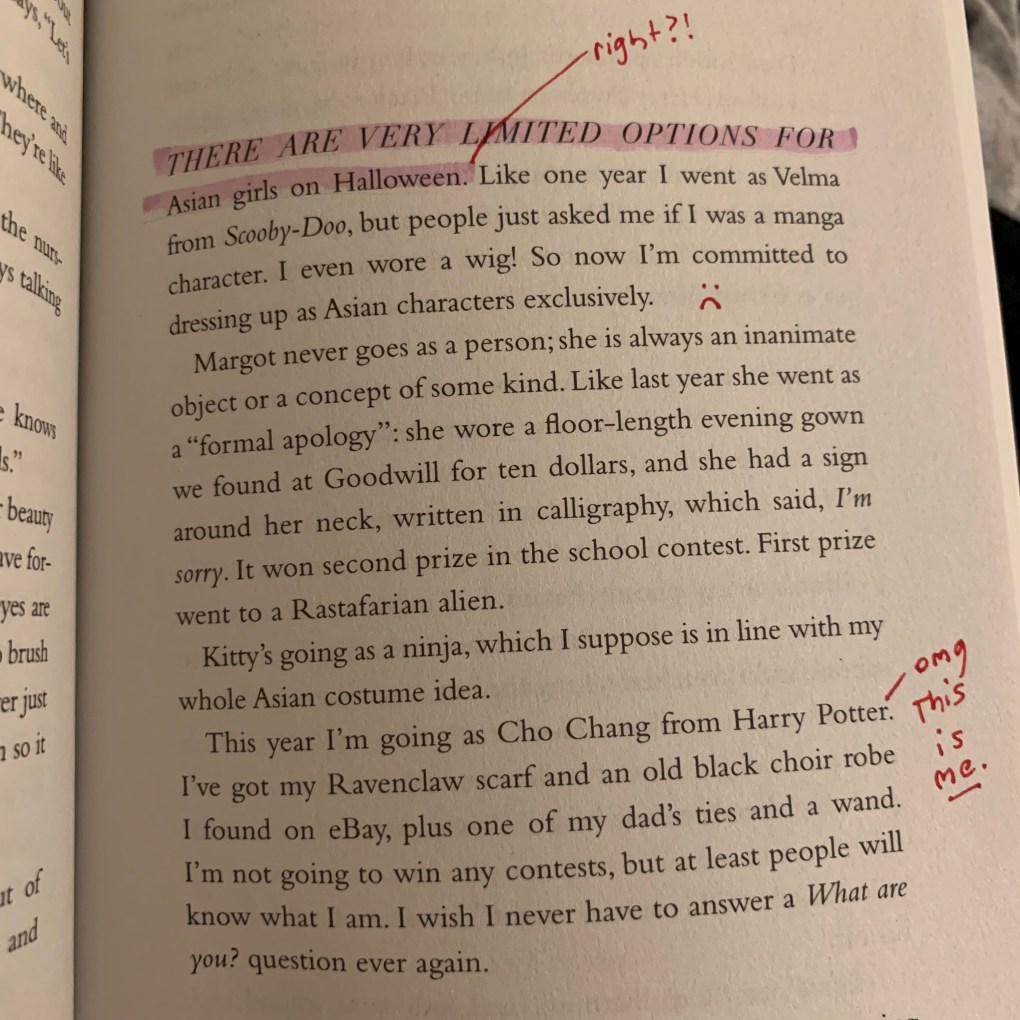
You see? It’s not that we don’t want to rock a Princess Leia or Hermione look. It’s because others would assume we are an Asian character.

Space Station Seventh Grade was a very offensive and racist book. That’s an aside that I don’t want to get into. But I just marvel at the long way we’ve come in terms of Asians in literature. Room for more of course!


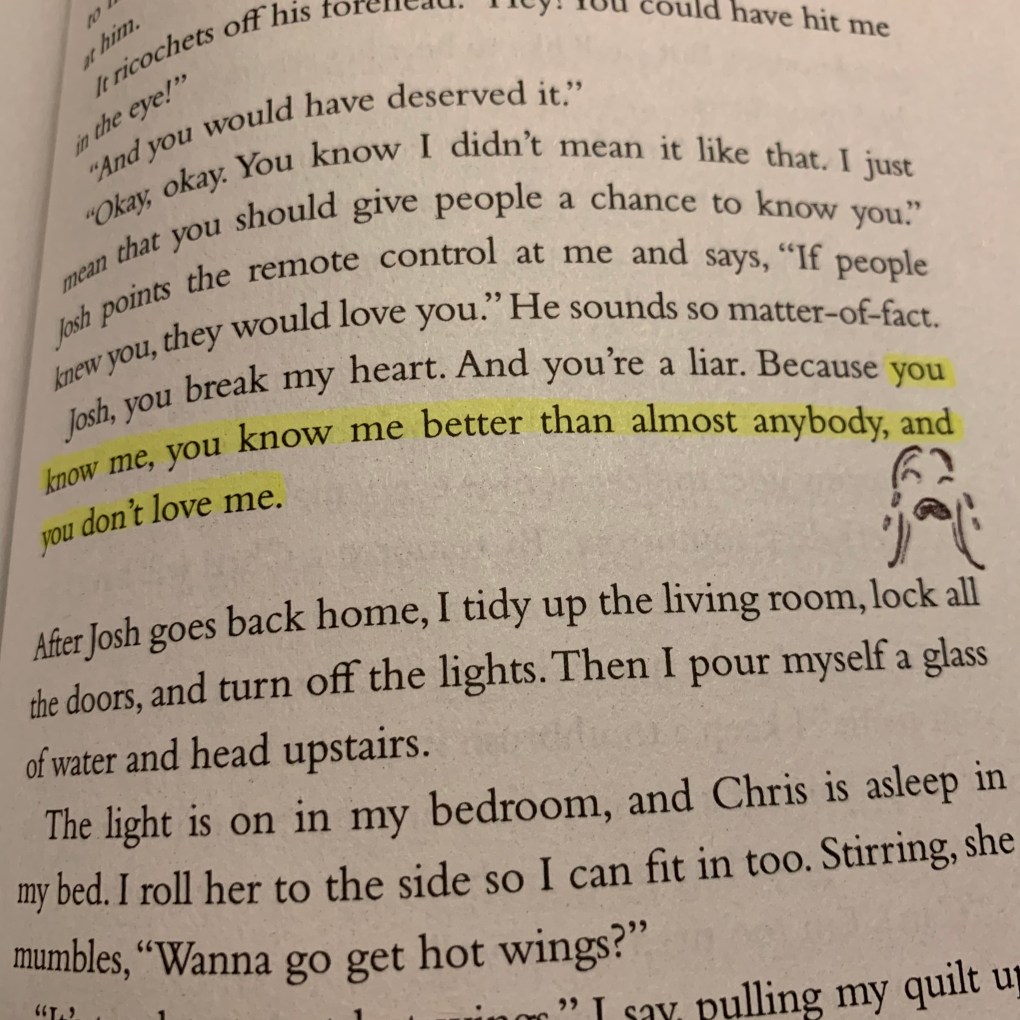
Lara Jean Song Covey, c’est moi

Currently Reading: To All the Boys I’ve Loved Before by Jenny Han, p. 223

Oh Lara Jean, one of the few Asian American girl protagonists out there in fiction, I relate with you so soo much. But this is also why I feel like punching you in the face.

One thing I really like about the book, though is that there is no insinuation of Lara Jean being unappealing as a girlfriend to any of her white peers because of being Asian. No one thinks that way in this book. That is nice. That is a nice fiction.

I swear I thought I’d be done with this book by now and into a nice Chevillard.


Predictions

Currently Reading: To All the Boys I’ve Loved Before by Jenny Han, p. 130

(Hushed whisper) This book is tedious.

Were you raised in grade school to keep reading logs? You would write a Prediction of what you think will happen in a story/chapter, and then write about your Reaction after reading? Don’t they understand this may stick with someone thru their adult life?


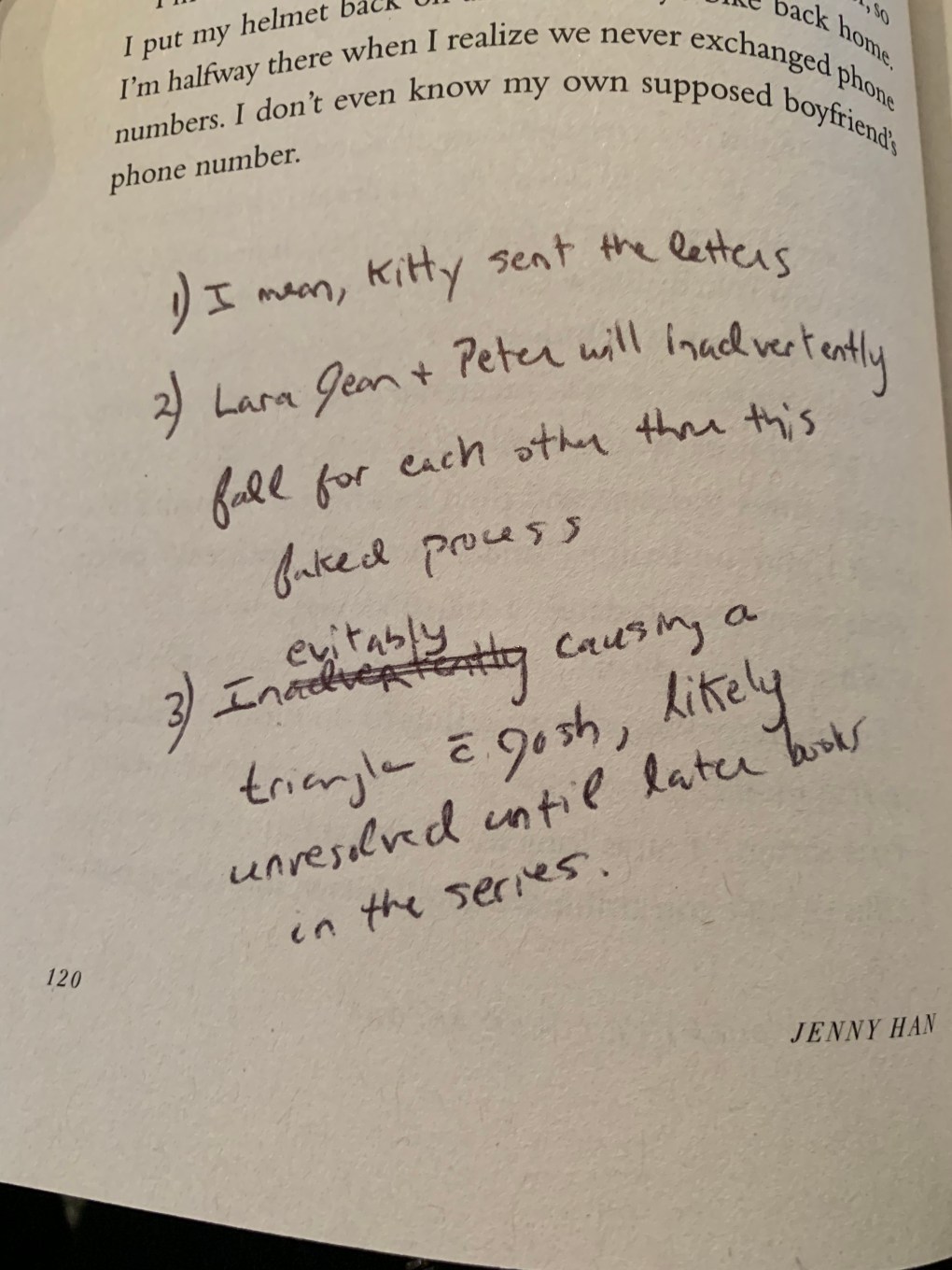
Late-Breaking YA Schmaltz

Currently Reading: To All the Boys I’ve Loved Before by Jenny Han

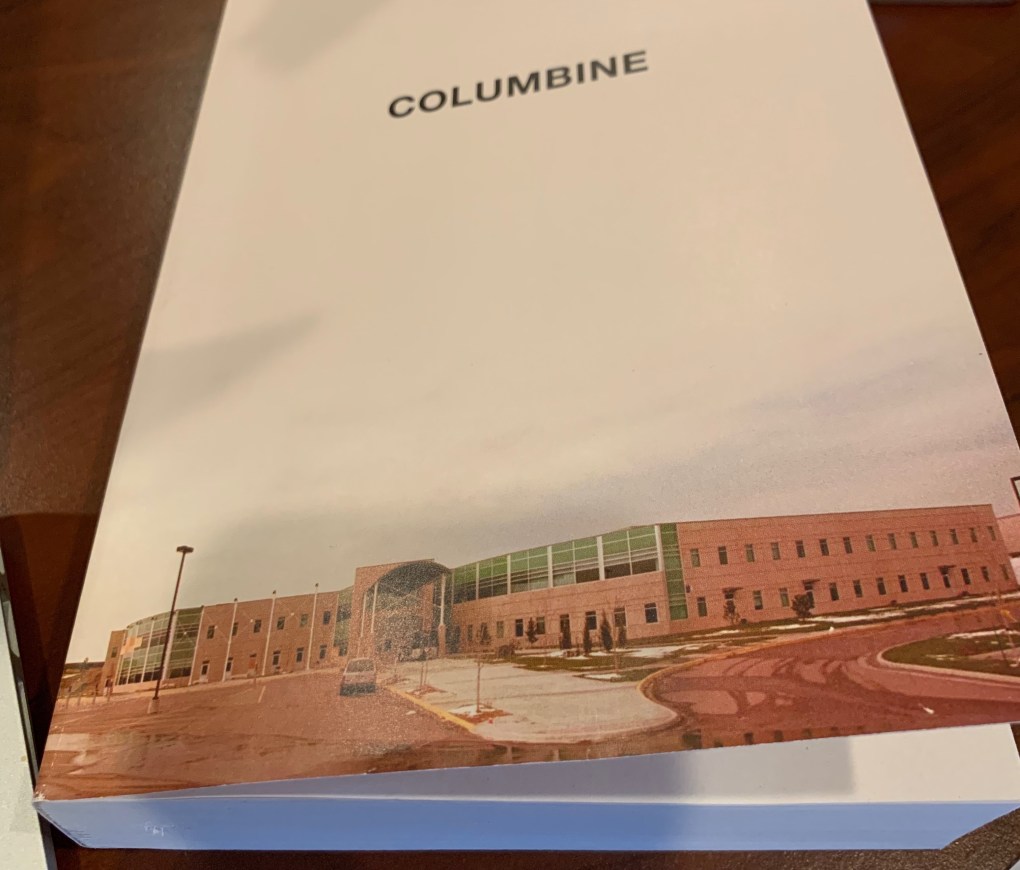
1) I just finished the horrific 400+ book detailing the Colombine shooting. I need something light. This book is the exaaaaact opposite of high school psycopaths shooting up their school. It is about a high school girl with crushies. As eyeroll inducing as it is, a high school girl with crushies is more relatable to me.

2) I’m a sucker for Asian American protagonists. And there is a dearth of Asian American protagonists.

3) My reading goal for the year was 40 books, and I have read 63. I want to maximize my book count by the end of the year, and can do so by reading short and fluffy things. After this I’ll be reading a lot of Chevillard.

4) It’s research for my own novel. I wrote a novel during NaNoWriMo 2017. My goal is to for-serious-revise and publish it within the next year, likely starting small with self-publishing venues at first. As much as I would like to think myself as a great literary author of depth, my novel falls most accurately under a love story involving young adults. Coming soon to a bookstore not near you! With an Asian American protagonist!

So how is TATBILB going? So far so good (page 62). I’m worried the protagonist is a little too passive at this point. I am hoping this is to set up her evolving into someone who would take more action. I am a fan of Rainbow Rowell, but many of her stories evolve around a girl/woman who is awesome, yet under-appreciated, and then someone sees how awesome she is, and good things just kind of happen to her by no doing of her own. I am the first to admit how privileged AF I am, which contributes a lot to where I am in life now. But if I think about it deeply, I did not acquire any of my current status/success/happiness without taking some form of action. There. I said it. Boom.


Why Columbine? Why Now?

Reading: Columbine by Dave Cullen

Strange choice to read around the holidays. Why read about this tragedy?

Well for one, I follow a reading podcast called Literary Disco, and a lot of my reading choices are derived from there. Earlier this year, they did a compelling two-part episode on Columbine. The first epi was devoted to discussing the book with current high school kids, in the wake of more recent school-based shootings. The second epi was a discussion with their English teacher about the demands of being an educator in this day and age, amidst the sensation that school (and other location) shootings are rampant.

With any major event/tragedy there is the tendency to recall where we were the moment it happened. I was nonexistent when JFK was shot. But I do hold in my mind where I was with 9-11-01. I was 20, a senior in college, watching TV in the AM before I headed out to campus. I saw in real-time the 1st Twin Tower crumble. I was literally floored. I was lying on the floor. I could not get up for awhile.

So what about Columbine? Here’s the thing–I should remember Columbine. It should have particular resonance for me: Spring 1999, I was a freshman in college, a mere one academic year older than a high school senior, with that life, that mind-frame still within me. And I was still within the academia world–on a school campus, a public setting prone to mass-kill scenarios.

I was aware of what happened. But so very peripherally to the point of shame. Why wasn’t I more aware? Why did it not affect me back then as it does now, with each publicized shooting pushing me deeper in despair? I would have had to been the most ignorant, shallow college freshman to not have followed the story with rapt horror.

So, in my self-actualized 38-year-old state (or, as I term myself, a highly-functioning awkward person) it is time to expand upon my social awareness. Historical awareness. Just…awareness in general.

This book ends up being more well-rounded than any information I would have gotten about the event had I been rapt at the time. It boils down to the emergence of real-time news/media reporting, which sustains to this day. Bottom line, as we are fed information about a significant event line by line, as the event unfolds, we lack the grander scope of what is actually happening. We are force fed trees, trees, trees; that no one can see forest. What this leads to, in the pressure to be the first to report, is erroneous information. So the conceptions we had about Columbine–motive for killing (jocks bullying outcasts who wanted revenge), trigger for killing (goths with M. Manson plugged in their ears brainwashed to kill), or meaning behind the killing (silly as it sounds now, forces of satan that would ultimately be washed out by forces of good)–were completely unfounded. No target, no trigger, no big message/purpose. Just psychopathy.

Dave Cullen’s book came out in 2009, ten years after the event. That is the amount of time he put into painstakingly researching every piece of evidence and account of Columbine. The end result is the most comprehensive, accurate, objective recount.

So if it is any consolation to my insulated, ignorant 18-year-old self, had I been more aware of Columbine when it happened, I would have likely been influenced to view the tragedy through some very biased information.


Why I Read

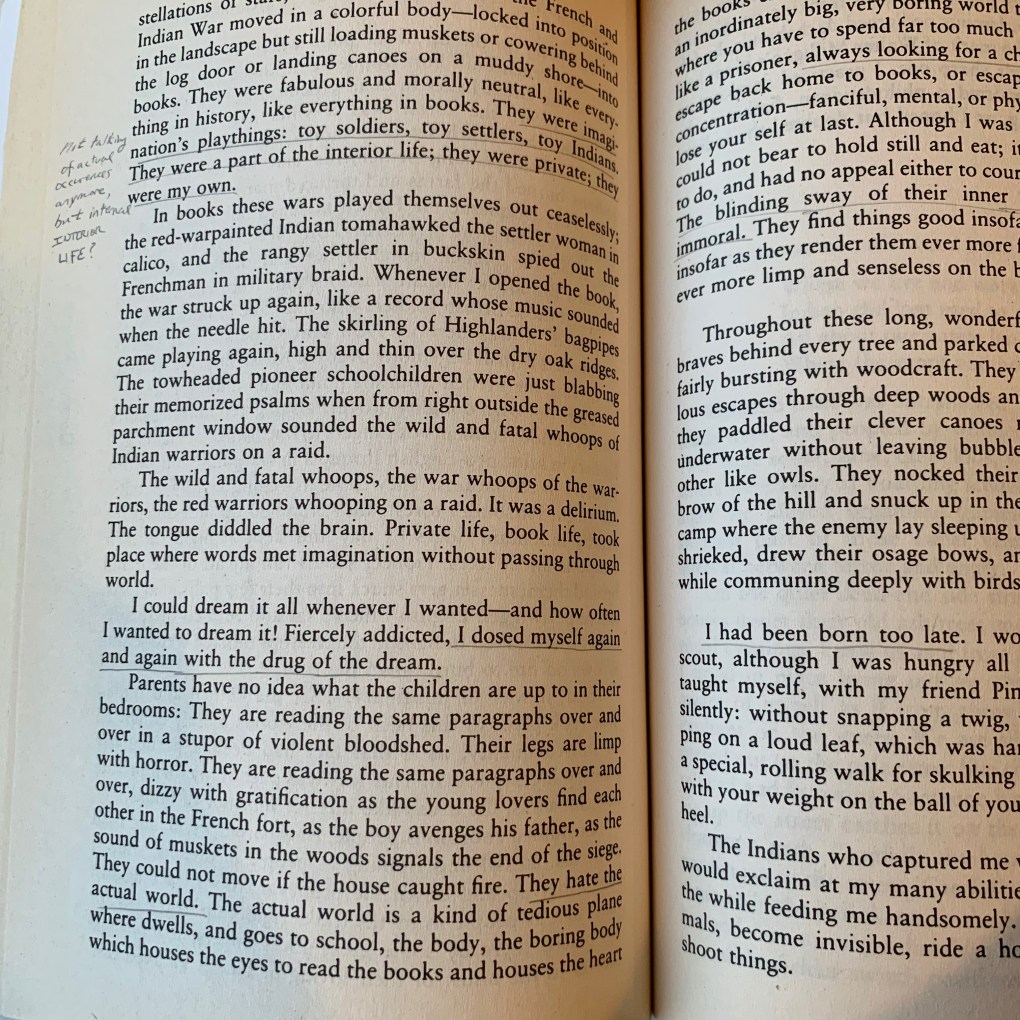
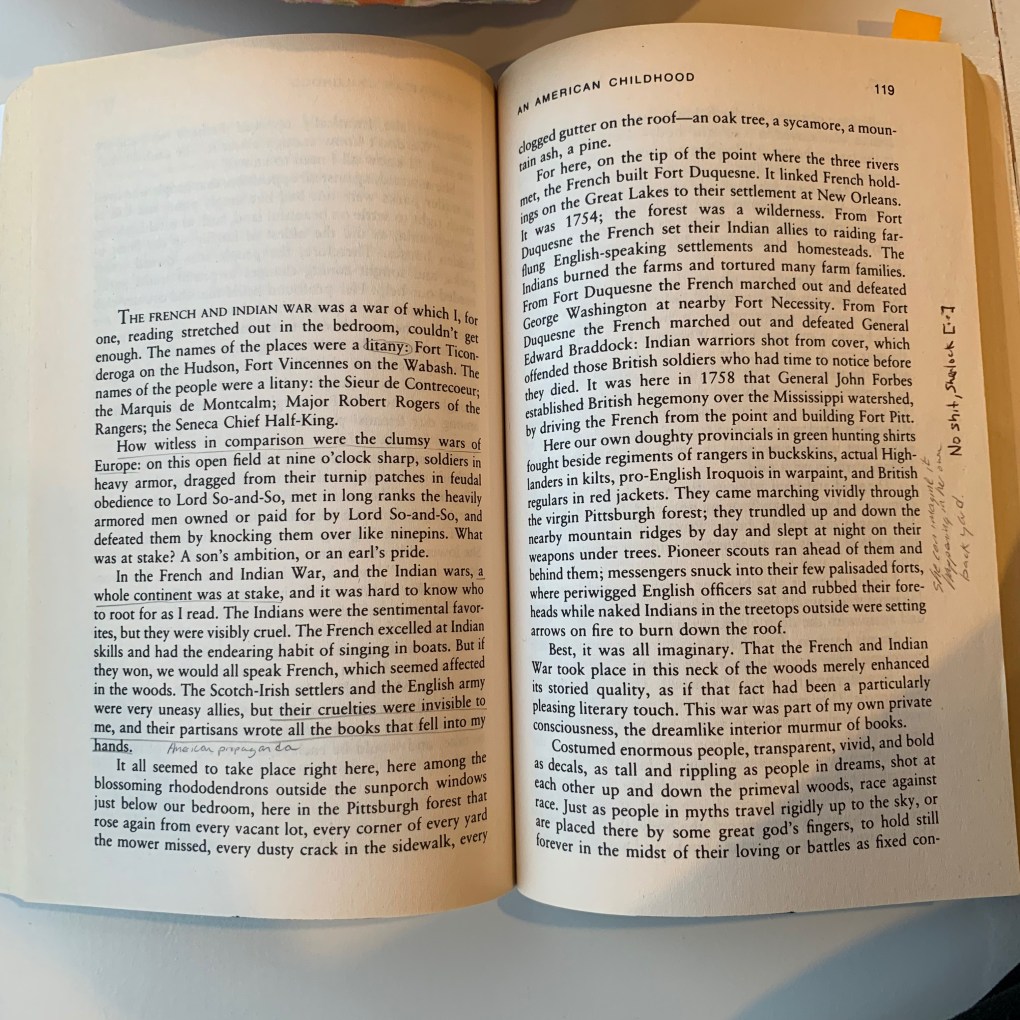
Since college, I have been an underliner, a highlighter, a note-in-the margin writer of text. I can remember the exact time this habit developed in me–down to the exact book. It was An American Childhood by Annie Dillard. In fact, if you look at my copy of the book, which I saved from my college years, you can see the exact moment it happened. On page 118, I circled the word “litany.” Prior to this encircling, the pages are devoid of underlining. After this line (and within every other book I owned thereafter) the pages are riddled with my marks and comments.

I look back at my own comments when I reread a book. Sometimes I cannot recall the exact mind-frame I had that compelled me to highlight something. Sometimes my margin notes are mysterious jargon I cannot figure out. More often though, I do remember what I was thinking at the time, and my current rereading self chides my past self for being so trite/underdeveloped. My current self sometimes even writes a scathing update margin note under the previous one. But my current self appreciates the effort of the close reading exercises. I like my old margin notes; it’s like a personal diary directly intermingled with what I was reading. And while, like any diary, some entries are cringe-worthy, I love how my interaction with the text is saved in my books for posterity.

IMG_0423

I read to maintain sustainable meaning out of a long-passed experience. This experience was transient, and probably for all parties involved save me, forgotten. But even for me, who remembers the past quite well, specific experiences will lose relevancy as the years plod on.

But if The Experience left me to be a good, thoughtful reader, then I can carry this skill forward with me to this day, and apply it to anything I read. And in turn, I can grab onto The Experience and make it current, meaningful, and with me always.


On Social Media Comportment

Currently Reading: An Absolutely Remarkable Thing by Hank Green

“In the end, my brand was me, so whatever I said became something I believed.”

These are things I think about these days:

  1. How our lives can be reduced to our social media personas
  2. How, with this current presidential administration, hatred has found a stronger voice
  3. How bipartisan politics has gotten extremely bipolar to the point of being destructive

This book takes a fantastical, yet played premise of alien invasion and spins it into a fresh parable for current times, simply by framing it within our social media-laden society. This framing is superbly executed, to the point where the premise becomes startlingly plausible. What would happen, in this day and age, if aliens randomly placed large robot-like statues throughout the world? Well, the event would be ignored until someone posts it on YouTube, and it becomes viral. How do the aliens spread word of their intentions? Through Wikipedia typos. What happens when the invasion sets off the whole world to have the exact same dream containing a myriad of puzzles to solve? Online communities develop to share their knowledge. Thus, the premise of alien invasion becomes less fantastical by parsing out of the event through social media. Interpreting the event via media platforms like Twitter, Facebook and Instagram is EXACTLY WHAT WE WOULD DO. Jarringly apt.

And what’s more, the main storyline of the book is not really about the alien invasion, it’s about how the girl who first YouTubed the event decides how to present herself; how she formulates her “brand,” apropos the aliens. Because that is ultimately what a modern-day girl would focus on–how she presents herself, on social media, amidst an alien invasion!

Then, there’s a man who sky-rockets to fame for presenting a dissenting view that the alien invasion is a hostile act. His fame is not related to how strongly he feels about this, or how eloquent he is, but simply because he was the first dissenting voice on a blog. He gains followers that are more passionate, they feel encouraged to voice their agreement, and the movement snowballs. It mirrors this current presidency–how our asshat president will Tweet out vitriol, and his bigoted/racist/fact-ignoring views are amplified by his supporters. It is symbiotic; those who may harbor hateful/wrong views feel validated by a president who voices these thoughts, and in turn they continue to support him. Loudly. Outloud. This is what scares me the most about America now more than Trump–his supporters transforming hateful thoughts into acts of hate. Cf. The Plot Against America.

The book then circles back to how the girl who first YouTubed the event decides to respond to the dissenter. She launches a forceful counter-arguments against him, not because she feels particularly convinced that the invasion is benevolent, but because the dissenting opinion is in opposition to her Brand. And staying On Brand necessitates her to forcibly dissent against the dissent. What is driving her more at this point–belief in the benevolence of the aliens, or wanting to stay On Brand? It mirrors extreme polar bipartisanship in this country. Disagreeing with the opposing political party, and dismantling their agenda has replaced thinking deeply about things, and thinking for oneself.

I love it when I’m reading a book and it mirrors what I am already thinking about. To be fair, I do end up framing everything I read into what I am currently thinking about, and current events. But this book takes away most of the work for me.


For Serious This Time

Perhaps you’ve heard of this story involving Gustave Flaubert. Not a story by him, about him. He is taking a stroll down the street and encounters a family scene. He utters, unironically, “Ils sont dans le vrai!” (We are in the truth!).

The details of this story differ, based on who tells it. But here’s the kicker: this anecdote turns up a lot, in other writers’ lives. Writers I have loved, like Franz Kafka and Philip Roth. Other writers are ostensibly obsessed with this little tale, this little phrase, and they spin it to fit their own lives/work. How powerful is that? To be so renowned a writer that something you utter (notably not something you wrote) becomes a resonating tale for other renowned writers?

And then, enter me (she says in parentheses) who keeps coming across this “Dans le Vrai” story in the things that I read. It seems like kismet. Or, an example of a “literary moment,” a term I define as an event whilst reading when I make a connection in my head to other things I have read that leave me jumping up and down in near-ecstasy. It has happened at least twice in my life. And it is the best feeling.

Thus, “dans le vrai” has taken up its own meaning for me, to fit my life. I have taken this phrase to signify  a “literary moment,” which is what drives me.

Anyway, all this to say: I am starting a blog, which will be about what I read and what I think about what I read. Are you bored? Then come on board!