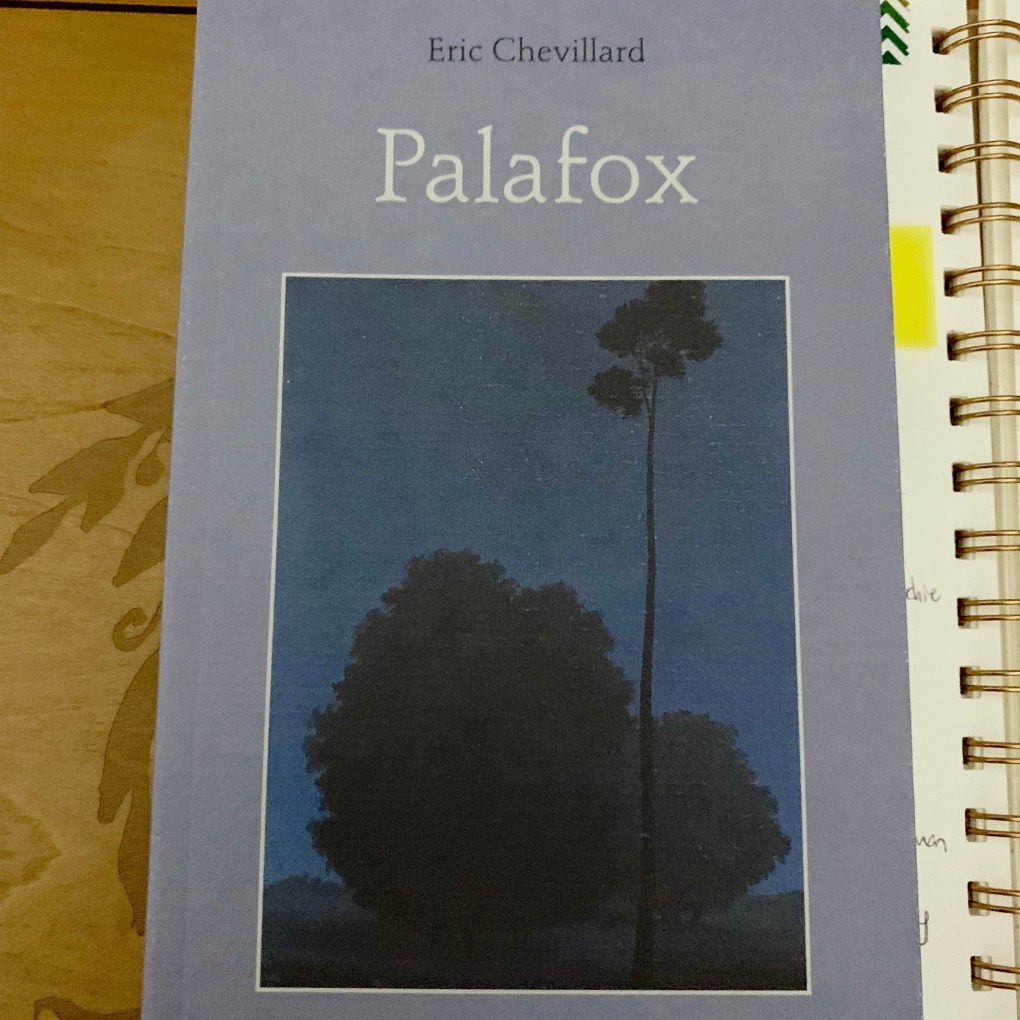
Currently Reading: Palafox by Eric Chevillard
This is what I call my Chevillard Syndrome: barely beyond page 1 of a Chevillard book/story…barely beyond the second paragraph, I have found that a smile has crept over my face. And it gradually turns into a full grin, and ultimately just ugly-cry-laughing.
Oh Chevillard! There’s just this…particular lilt to his narrative, so inherently Chevillard-y. It sets me into a specific this mind-frame when I get into his work, even if it has been 8 months since I last read him. Mind you, I have not read much of his oeuvre (yet), but I find his narrative tendencies habitual and reassuring. Like revisiting an old friend.
I read Crab Nebula about one year ago. Palafox was penned first. Aside from the same Chevillard-y tone, the stories are very similar. Crab Nebula is comprised of a series of unrelated passages, describing an overall undefinable human named Crab. Similarly, Palafox is about an undefinable animal, but descriptions of him are set within a story. Palafox’s descriptives keep changing through the narrative- he is born from an egg, he has feathers, fur…seemingly scales and horns. He weighs 2 tons, yet fits in a paper envelope. You can ride upon his back in water, then tuck him under your arm as you get out. And it is not that he is a changeling…it is that he is all of these things at once. It’s absolutely amazing! Amazing when you simply let go of reasoning with it. Rest assured, it’s all intentional, so just roll with it.
What Palafox reminds me of:
- (Early on) The Magic Mountain, but paced much better (instead of spanning 700+ pages, more like 136). In that, early on, I just want to hear about the descriptives of Palafox, but there are frequent asides about a war, pieces of furniture, and the specific study and experiences of various zoologists. It’s like when I read The Magic Mountain and all I wanted to read about were the spellbinding interactions between Hans Castorp and Madame Chauchat (“My God! My God!”), but these scenes are encased within long passages involving the pedantic humanist. Erg. But (sob!) that is the beauty of the book!
- Kafka’s Odradek. A description of a star-shaped spool of thread, seemingly many contradicting things at the same time. “I dare you to draw the Odradek!” I said in my head smugly. Then I Googled images of it, and indeed, people have drawn/designed the Odradek. Well, go you guys.
Another think I love about Palafox is the undefinable narrator, as equally undefinable as Palafox himself. The story seemingly starts out third person omniscient, but toward halfway I started detecting “I’s” and “We’s.” Who is the narrator? He seems within the mix of the action, always present in every circumstance. But he supplies no self-identification. I cannot place him as a family member of Algernon and Maureen, nor a zoologist. The most I can glean out of him is that he once killed a boar. What kind of narration is that? First-person-omniscient/omnipresent-yet-removed? Well whatever it is, it is brilliant. Who wouldn’t want to write like that? Complete authority over the story, ostensibly present within the story, but otherwise exuding no influence/bias?
 danslevrai.net